
 By Admin
Legal information, not legal advice. Laws vary by state, always confirm current rules with your state child support agency or a licensed family-law attorney.
Raising a child after separation or divorce comes with a financial reality that both parents have to face: child support. For many parents, the process feels confusing, how is the amount decided? What happens if a parent doesn’t pay? Can the amount change later?
This guide breaks down how child support works in the United States, how it’s calculated, and what tools the law gives parents (and the state) to enforce it, so you know exactly where you stand.
What Is Child Support?
Child support is a court-ordered financial payment made by one parent to the other (or, in some cases, to a guardian) to help cover the cost of raising a shared child. It’s based on the legal principle that both parents are financially responsible for their children, regardless of the parents’ relationship status or custody arrangement.
Child support is meant to cover a child’s essential needs, including:
- Housing and utilities
- Food and clothing
- Education expenses
- Healthcare and medical costs
- Childcare while the custodial parent works
Child support is a right that belongs to the child, which is why parents generally cannot waive it or agree to skip it, even if both agree.
How Child Support Works in the U.S.
Child support is governed primarily by state law, not federal law, though federal guidelines require every state to have a formula and enforcement system in place. This means:
- The calculation formula differs from state to state.
- The minimum and maximum support obligations differ.
- Enforcement tools and timelines differ.
- What counts as “income” for support purposes can differ.
Because of this, two parents with similar incomes and custody schedules could have noticeably different support obligations depending on which state has jurisdiction over their case. Always check your specific state’s child support guidelines or consult a family-law attorney for numbers that apply to your situation.
Who Has to Pay Child Support?
Child support obligations typically apply when parents are:
- Divorced
- Legally separated
- Never married but share a child (once paternity is legally established)
- Living apart under a custody or parenting plan
The parent who has the child less than 50% of the time is usually the one who pays support to the parent with primary physical custody. In shared or joint custody arrangements, courts often calculate support based on each parent’s income and the actual number of overnights with the child, which can significantly change who pays and how much.
How Is Child Support Calculated?
States use one of three main models to calculate child support. Understanding which model your state uses helps you understand why the number comes out the way it does.
1. Income Shares Model (used by most states)
This model estimates what the parents would have spent on the child if the family were still together, then divides that amount between both parents based on their proportional share of combined income.
2. Percentage of Income Model
This model calculates support as a set percentage of the paying parent’s income, based on the number of children. Some states use a flat percentage, others use a variable percentage that adjusts with income level.
3. Melson Formula
Used by a small number of states, this is a more detailed version of the income shares model. It first ensures each parent retains enough income to meet their own basic needs, then allocates remaining income toward the child’s needs and a share of any additional income.
Common Factors That Affect the Final Number
Regardless of model, most states also factor in:
- Gross income of both parents (wages, self-employment income, bonuses, and in some cases benefits)
- Number of children covered by the order
- Parenting time / overnights with each parent
- Health insurance premiums paid for the child
- Childcare costs required for a parent to work or study
- Extraordinary medical or educational expenses
- Existing support obligations for children from other relationships
Most states publish an official child support calculator or worksheet through their state court or child support agency website, using the official tool for your state is the most reliable way to estimate an actual figure.
What Counts as Income for Child Support?
States generally cast a wide net when defining income, often including:
- Salary and hourly wages
- Self-employment and business income
- Bonuses and commissions
- Overtime pay (in many states)
- Rental income
- Investment income
- Unemployment or disability benefits
Courts can also impute income, meaning they assign an income level to a parent who is voluntarily unemployed or underemployed, to prevent parents from avoiding support by deliberately earning less.
How Long Does Child Support Last?
In most states, child support continues until the child turns 18, or later if the child is still in high school. Some states extend support:
- Through college in specific circumstances
- Indefinitely for a child with a significant disability
- Until a different age set by that state’s law
Support can also end earlier due to emancipation, marriage of the child, or the child’s death. Always confirm your state’s specific termination rules, since this varies more than most people expect.
Can Child Support Be Changed Later?
Yes. Child support orders aren’t necessarily permanent. A parent can typically request a modification when there’s been a significant change in circumstances, such as:
- A major increase or decrease in either parent’s income
- Job loss or disability
- A change in the custody or parenting time schedule
- A change in the child’s needs (medical, educational, etc.)
Most states require the change to be substantial, not a minor, temporary shift, and modifications generally have to go through the court; parents can’t simply agree informally to a different amount and expect it to be enforceable.
Enforcement of Child Support
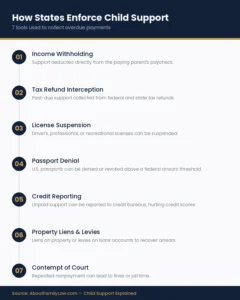
Once a support order is in place, it’s legally binding. If a parent falls behind on payments (creating what’s called “arrears“), states have several enforcement tools available, often applied through the state’s child support enforcement agency.
Common Enforcement Methods
- Income withholding — Support is automatically deducted from the paying parent’s paycheck, which is the most common enforcement method in the U.S.
- Tax refund interception — Past-due support can be collected from federal and state tax refunds.
- License suspension — States can suspend driver’s licenses, professional licenses, and even recreational licenses for significant nonpayment.
- Passport denial — The federal government can deny or revoke a passport for parents with substantial arrears (typically above a set federal threshold).
- Credit reporting — Unpaid child support can be reported to credit bureaus, affecting the paying parent’s credit score.
- Property liens and bank levies — States can place liens on property or seize funds from bank accounts.
- Contempt of court — In more serious or repeated cases, a parent can be held in contempt of court, which can result in fines or even jail time.
These tools exist to make sure children actually receive the support they’re owed, and enforcement can escalate quickly once a case is referred to a state agency.
What to Do If a Parent Isn’t Paying Child Support
If you’re owed child support and payments have stopped or become inconsistent:
- Document everything — Keep records of missed or partial payments.
- Contact your state child support enforcement agency — Most cases opened through the state office can access automatic enforcement tools without you having to go back to court alone.
- File a motion for contempt or enforcement — If the case isn’t already with a state agency, an attorney can help file directly with the court.
- Avoid taking matters into your own hands — Withholding parenting time in retaliation for missed payments can create separate legal problems, since custody and support are treated as legally distinct issues by most courts.
What to Do If You Can’t Afford Your Child Support Payment
If your financial situation has genuinely changed:
- Don’t simply stop paying – arrears continue to accrue and can trigger enforcement action, even if the reason for missing payments was legitimate.
- File for a modification as soon as possible; most states only adjust the order going forward, not retroactively.
- Keep records of income loss, medical issues, or other qualifying changes to support your request.
Child Support and Taxes
A few points worth knowing:
- Child support payments are not tax-deductible for the paying parent.
- Child support received is not considered taxable income for the receiving parent.
- Claiming a child as a dependent for tax purposes is a separate issue from child support and is usually addressed in the custody or divorce agreement.
Tax treatment can affect financial planning around support, so it’s worth reviewing with a tax professional when finalizing or modifying an order.
Common Mistakes Parents Make With Child Support
- Agreeing to informal, off-the-record payment arrangements instead of going through the court
- Assuming child support and custody/visitation are linked (they’re legally treated as separate issues)
- Not requesting a modification when circumstances genuinely change
- Missing payments without informing the court, allowing arrears to build up
- Not keeping proof of payments made outside of automatic withholding
Final Thoughts
Child support exists to protect a child’s right to financial support from both parents, not to punish either parent. Understanding how your state calculates and enforces support helps you plan accordingly, whether you’re the paying or receiving parent.
Because child support rules vary meaningfully from state to state, and because enforcement and modification cases can carry real financial and legal consequences, it’s worth speaking with a licensed family-law attorney for guidance specific to your case. For a broader look at how child support fits into the divorce and custody process, visit our family law resource center at AboutFamilyLaw.
Frequently Asked Questions
Does child support automatically stop at age 18?
In most states, yes, though it can continue if the child is still in high school or has a qualifying disability. Some states extend support further under specific conditions.
Can child support be waived if both parents agree?
Generally, no. Child support belongs to the child, so courts typically won’t approve an agreement that eliminates support entirely, even with both parents’ consent.
Does remarriage affect child support?
A new spouse’s income generally isn’t counted directly in the child support calculation, though it can indirectly affect a parent’s overall financial situation in some states’ guideline calculations.
What happens if the paying parent moves out of state?
Child support orders remain enforceable across state lines under the Uniform Interstate Family Support Act (UIFSA), which allows states to cooperate on enforcement even when parents live in different states.
Is child support based only on the paying parent’s income?
Not usually. Most states factor in both parents’ incomes, along with custody time and specific child-related expenses, rather than basing support solely on one parent’s earnings.