
 By Noah
When parents separate or divorce, one of the most important questions is how decisions about their children will be made and where the children will live. This is where child custody comes into play.
Child custody generally addresses two different issues: legal custody, which concerns who has authority to make major decisions for a child, and physical custody, which concerns where the child lives and how parenting time is divided. Either type of custody can be shared by both parents or awarded primarily to one parent, depending on the circumstances and the law of the state involved.
Terms such as joint custody, sole custody, primary physical custody, and parenting time can be confusing, especially when parents are already dealing with the emotional and financial consequences of separation.
This guide explains the major types of child custody in the United States, how courts generally make custody decisions, what parenting plans can cover, and what parents should understand before agreeing to or asking for a custody order.
Important: Child custody laws are state-specific. The terminology, legal standards, required forms, court procedures, and factors considered by a judge can differ significantly from one state to another. This article provides general legal information, not legal advice about a particular family or case.
What Is Child Custody?
Child custody refers broadly to the legal rights and responsibilities concerning the care, residence, and major decisions affecting a minor child.
In the United States, custody is commonly divided into two categories:
- Legal custody: authority to make important decisions about the child’s upbringing.
- Physical custody: responsibility for the child’s day-to-day care and where the child lives.
These two forms of custody do not necessarily have to be awarded to the same parent. For example, one parent may have primary physical custody while both parents share legal custody.
Some states use different terminology. Instead of “legal custody,” a state may refer to decision-making authority, parental responsibilities, or similar concepts. Instead of “physical custody,” a state may use terms such as parenting time, residential custody, or physical care.
Because of these differences, parents should check the terminology used by their state court.
Legal Custody vs. Physical Custody
Understanding the difference between legal and physical custody is one of the most important parts of understanding a custody order.
What Is Legal Custody?
Legal custody concerns the authority to make major decisions affecting a child’s life.
Depending on state law and the specific court order, major decisions may include matters such as:
- Education and schooling
- Non-emergency medical care
- Mental health treatment
- Religious upbringing
- Major extracurricular activities
- Other significant issues affecting the child’s welfare
Joint legal custody generally means both parents share responsibility for major decisions. Sole legal custody generally means one parent has the authority to make those decisions.
Joint legal custody does not necessarily mean the child spends equal time in each parent’s home.
What Is Physical Custody?
Physical custody concerns where a child lives and which parent provides day-to-day care.
A child may live primarily with one parent while spending substantial parenting time with the other. Alternatively, the parents may share physical custody under a schedule that divides the child’s time between their homes.
Importantly, joint physical custody does not automatically mean a 50/50 schedule. The actual schedule depends on the parents’ circumstances, the child’s needs, the court’s order, and applicable state law.
What Are the Main Types of Child Custody?
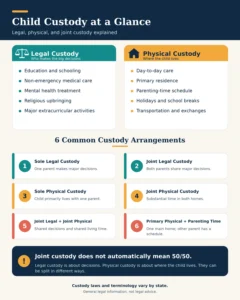
Although terminology varies by state, the most common custody arrangements include:
- Sole legal custody
- Joint legal custody
- Sole physical custody
- Joint physical custody
- Joint legal and joint physical custody
- Primary physical custody with parenting time for the other parent
These categories can overlap. A parent might have sole physical custody but share legal custody, for example.
1. Sole Legal Custody
Sole legal custody means one parent has the legal authority to make major decisions concerning the child.
The other parent may still have parenting time and may have other parental rights. Sole legal custody does not automatically mean that the other parent has no relationship with the child.
Whether a court awards sole legal custody depends on the facts of the case and the applicable state law.
2. Joint Legal Custody
Joint legal custody means both parents share responsibility for major decisions concerning the child.
Parents with joint legal custody generally need to communicate and cooperate on significant issues. The precise decision-making rules can vary by state and by court order.
For example, an order might require both parents to agree before making a major educational or medical decision, while allowing either parent to make routine day-to-day decisions during that parent’s parenting time.
Joint legal custody is therefore about decision-making authority, not necessarily equal residential time.
3. Sole Physical Custody
Sole physical custody generally means the child primarily lives with one parent.
The other parent may receive parenting time according to a schedule established by agreement or court order.
A parent with sole physical custody may therefore be the child’s primary residential parent without necessarily having sole legal custody.
4. Joint Physical Custody
Joint physical custody means the child spends substantial time living with both parents.
The schedule could involve:
- Alternating weeks
- Several days with one parent followed by several days with the other
- Weekday/weekend arrangements
- School-year and summer schedules
- Other arrangements tailored to the family
There is no universal requirement that joint physical custody be exactly 50/50.
5. Joint Legal and Joint Physical Custody
Some families share both decision-making authority and substantial residential time.
This arrangement can work well when parents can communicate effectively, live close enough to make the schedule practical, and consistently place the child’s needs ahead of parental conflict.
However, joint custody is not automatically appropriate for every family. Courts generally focus on the child’s best interests and the circumstances of the particular case.
What Is the Difference Between Custody and Parenting Time?
Custody and parenting time are related but are not always the same thing.
Custody generally describes legal decision-making authority and/or physical care.
Parenting time describes when a parent spends time with the child.
For example, two parents might share legal custody while one parent has the child’s primary residence and the other parent has a detailed parenting-time schedule.
A parenting-time schedule can address ordinary weekdays and weekends as well as:
- School holidays
- Summer vacations
- Birthdays
- Mother’s Day and Father’s Day
- Religious holidays
- School breaks
- Travel
- Transportation
- Pickup and drop-off arrangements
The exact terminology depends on the state.
How Do Courts Decide Child Custody?
When parents cannot agree, a court may be required to determine custody.
Across the United States, the central concept is generally the best interests of the child, although individual states define and apply that standard differently.
Courts may consider factors such as:
- The child’s physical and emotional needs
- Each parent’s ability to meet those needs
- The child’s relationship with each parent
- The child’s relationship with siblings and other important family members
- Stability of each parent’s home environment
- Each parent’s ability to provide appropriate care
- The child’s education and health needs
- Each parent’s ability to support the child’s relationship with the other parent, where appropriate
- History of domestic violence, abuse, neglect, or other safety concerns
- The child’s preferences, where state law permits or requires the court to consider them
- The practical feasibility of a proposed parenting schedule
- Other factors identified by state law
The factors are not identical nationwide. The American Bar Association’s survey of state custody statutes demonstrates how significantly custody terminology and statutory best-interest factors vary among states.
Does a Mother Automatically Get Custody?
Generally, parents should not assume that a mother automatically receives custody simply because she is the mother.
Modern custody decisions generally focus on the child’s best interests rather than automatically awarding custody based on a parent’s gender. State laws and individual facts still matter, however.
Does a Father Have a Right to Custody?
A father may have custody or parenting-time rights, but the exact legal position depends on the circumstances and the state’s laws.
For married parents, unmarried parents, parents who have established legal parentage, and parents involved in an existing custody order, the applicable rules can differ.
A parent should not assume that informal arrangements automatically provide the same protection as a legally enforceable custody order.
What Is a Parenting Plan?
A parenting plan is a written arrangement describing how parents will share responsibility for and time with their child.
Depending on state law, a parenting plan may address:
- Where the child will live
- When the child will be with each parent
- Holiday schedules
- School vacations
- Transportation
- Pickup and drop-off arrangements
- Communication between the child and each parent
- Decision-making responsibilities
- Medical and educational decisions
- Extracurricular activities
- Travel
- How parents will handle disagreements
- How expenses outside ordinary child support will be addressed
A detailed plan can reduce future disagreements because both parents have a clearer understanding of what is expected.
However, parents should not assume that a parenting-plan template from another state will satisfy their own state’s requirements.
What Happens When Parents Agree on Custody?
Parents who are able to reach an agreement may be able to submit a proposed parenting plan or custody agreement to the court.
Depending on the state and type of proceeding, a judge may review the agreement before entering it as a court order.
An agreement can often provide parents with more flexibility than leaving every detail to a judge. It can also allow parents to create arrangements tailored to the child’s school schedule, activities, medical needs, and family circumstances.
But parents should understand the legal effect of anything they sign.
A parenting agreement may become enforceable once incorporated into a court order, and changing it later may require following a formal legal process.
What If Parents Cannot Agree?
When parents cannot agree on custody, the dispute may become contested.
Depending on the state and case, the process may involve:
- Filing a custody or family-law case
- Service of legal documents
- Temporary custody or parenting-time orders
- Mediation or another form of dispute resolution
- Exchange of information and evidence
- Parenting-plan proposals
- Hearings
- Evaluation or appointment of a guardian ad litem or other professional in some circumstances
- A trial or evidentiary hearing
- A final custody order
The exact process varies by jurisdiction.
Parents should obtain the forms and procedural instructions directly from the appropriate state or local court. State family courts are generally the appropriate source for current filing requirements, forms, deadlines, and local procedures. USAGov provides a starting point for locating state and territorial courts.
Does Child Custody Determine Child Support?
Not necessarily.
Child custody and child support are related but legally distinct issues.
A parent may have substantial parenting time and still have a child-support obligation, depending on state law and the parents’ incomes and other circumstances.
Likewise, having primary physical custody does not automatically determine the amount of child support.
Child-support calculations can consider factors such as:
- Each parent’s income
- Number of children
- Health-insurance costs
- Child-care expenses
- Parenting time
- Other legally recognized expenses or obligations
Because child-support guidelines differ by state, parents should use the applicable state guidelines rather than relying on a general national calculation.
How Does Custody Affect Taxes?
Custody arrangements can also affect federal tax matters, but custody orders and IRS rules are not the same thing.
Generally, for federal tax purposes, the custodial parent is the parent with whom the child lived for the greater number of nights during the year. Special rules can allow the noncustodial parent to claim certain child-related tax benefits when the applicable requirements are satisfied, including a qualifying release such as Form 8332 in appropriate circumstances.
Parents should not assume that a divorce decree or parenting plan automatically determines every federal tax benefit.
The IRS also explains that only one person generally can claim a qualifying child for a particular tax year, subject to applicable special rules and tie-breaker provisions.
What Happens When One Parent Wants to Move?
Relocation can become one of the most difficult custody issues after separation or divorce.
Moving a short distance may have little effect on an existing parenting schedule. Moving to another city, state, or country can be much more significant.
A relocation may affect:
- School arrangements
- Transportation
- Parenting time
- Holiday schedules
- Communication
- Existing custody orders
- The child’s relationship with each parent
Some states require advance notice or court approval before a parent can relocate with a child when the move affects an existing custody arrangement.
Because relocation law varies substantially, a parent should review the existing custody order and applicable state law before moving rather than assuming that moving first and asking for permission later will be acceptable.
What Happens When Parents Live in Different States?
Interstate custody disputes can raise jurisdiction issues.
The Uniform Child Custody Jurisdiction and Enforcement Act (UCCJEA) is designed to reduce competing custody orders between states by establishing jurisdictional rules and mechanisms for recognizing and enforcing custody orders. Its adoption and implementation are matters of state law.
A parent should obtain legal advice promptly if:
- The parents live in different states
- A child recently moved to another state
- A parent plans to relocate
- There are competing custody cases
- A parent believes the child has been wrongfully taken to another state
International custody disputes can involve additional laws and treaties and should be treated as urgent legal matters.
What If There Is Domestic Violence or Abuse?
Domestic violence can substantially change how custody and parenting time should be approached.
Parents should not assume that a standard cooperative co-parenting arrangement is appropriate where there are credible safety concerns.
Courts and professionals may consider domestic violence, abuse, threats, and their effects on the child when addressing custody and parenting time. The U.S. Department of Justice has specifically emphasized that custody processes involving domestic violence should account for the nature and context of the abuse and its implications for children and parents.
Depending on state law and the facts, protective measures can include:
- Supervised parenting time
- Supervised exchanges
- Neutral exchange locations
- Restrictions on contact
- Conditions placed on parenting time
- Temporary emergency orders
- Confidentiality protections
- Other safety measures
The precise remedies differ by state.
If you or your child is in immediate danger, prioritize safety and contact emergency services or an appropriate domestic-violence resource. In a custody proceeding involving abuse, speaking with a lawyer or qualified domestic-violence advocate can help you understand available protections.
Can a Custody Order Be Changed?
Yes, custody orders can sometimes be modified.
The requirements vary by state. A court may require a parent to demonstrate a significant or legally recognized change in circumstances and that the proposed modification serves the child’s best interests.
Examples of circumstances that may lead a parent to seek modification can include:
- A major change in the child’s needs
- A substantial change in a parent’s circumstances
- Relocation
- Serious problems with the existing parenting arrangement
- Safety concerns
- Persistent failure to follow the existing order
- Changes affecting school or medical needs
A parent should not simply stop following an existing custody order because they believe circumstances have changed.
Until a court changes the order, parents generally need to understand and comply with the existing order unless an applicable exception under state law applies.
What If the Other Parent Violates the Custody Order?
A parent who believes the other parent is violating a custody order should carefully document what happened and review the enforcement procedures available in the relevant state.
Possible issues can include:
- Repeatedly denying parenting time
- Failing to return a child on time
- Refusing required communication
- Violating exchange provisions
- Taking the child somewhere prohibited by the order
- Making major decisions contrary to the custody order
The appropriate legal response depends on the circumstances.
Parents should avoid retaliating by violating the custody order themselves. Instead, they should consider the lawful enforcement or modification procedures available in their jurisdiction.
What Evidence Can Be Useful in a Custody Case?
A custody case should generally focus on evidence relevant to the child’s welfare and the legal factors applied by the court.
Depending on the circumstances, relevant evidence might include:
- School records
- Medical records
- Parenting schedules
- Communication between parents
- Evidence of missed parenting time
- Documentation of transportation problems
- Evidence concerning housing or stability
- Records relating to domestic violence or abuse
- Child-care arrangements
- Evidence of the child’s educational or medical needs
Parents should avoid turning a custody dispute into a campaign of personal attacks.
Courts are generally interested in evidence that helps them determine what arrangement serves the child’s interests, not simply which parent can make the most accusations against the other.
Common Child Custody Mistakes to Avoid
1. Assuming “joint custody” means 50/50
Joint custody can take different forms. Joint legal custody and joint physical custody are separate concepts.
2. Relying on a verbal agreement
An informal agreement may work temporarily, but parents should understand whether their arrangement is legally enforceable.
3. Ignoring the details of a parenting schedule
A vague agreement can create disputes over holidays, transportation, vacations, school events, and other recurring issues.
4. Moving without checking the law
Relocation can have serious legal consequences when a custody order is involved.
5. Using child support as leverage
Custody and child support are separate legal issues. Parents should not assume that withholding parenting time or support is an appropriate response to the other parent’s conduct.
6. Violating an existing court order
If circumstances have changed, the safer legal approach is generally to seek an appropriate modification rather than unilaterally ignoring the order.
7. Putting the child in the middle
Parents should avoid asking children to choose sides, using them to communicate hostile messages, or discussing litigation with them in ways that create unnecessary emotional pressure.
8. Assuming every state uses the same terminology
State custody laws differ. A parenting arrangement described as “custody” in one state may be expressed through different terminology in another.
How Parents Can Prepare for a Custody Case
Before filing or responding to a custody case, a parent can start by organizing the information that is likely to matter.
Consider creating a record of:
- The child’s normal weekly schedule
- School and extracurricular activities
- Medical needs
- Existing parenting arrangements
- Transportation responsibilities
- Important communication with the other parent
- Relevant court orders
- Any safety concerns
- Proposed parenting schedules
It can also help to think about practical questions before proposing a parenting plan:
- Where will the child attend school?
- How will transportation work?
- How will holidays be divided?
- Who will handle medical appointments?
- How will parents communicate?
- What happens when the child is sick?
- How will vacations be scheduled?
- How will parents handle disagreements?
- What happens when the child’s schedule changes?
The goal should be a plan that is workable in real life, not merely one that sounds fair on paper.
Can Parents Use Mediation?
In some cases, parents can resolve custody disputes through mediation or another form of alternative dispute resolution.
Mediation may give parents an opportunity to negotiate issues such as:
- Parenting time
- Decision-making
- Holidays
- Transportation
- Communication
- School-related issues
- Other parenting-plan terms
Mediation is not appropriate for every situation.
When domestic violence, coercive control, intimidation, or significant safety concerns are present, parents should consider whether mediation is safe and appropriate. The U.S. Department of Justice has emphasized the importance of custody dispute-resolution processes that account for domestic violence and are safe and fair.
How Long Does a Custody Case Take?
There is no single nationwide timeline.
An uncontested custody agreement may be resolved relatively quickly, depending on the state’s procedures and the court’s schedule.
A highly contested case may take considerably longer, particularly when it involves:
- Multiple hearings
- Expert evaluations
- Allegations of abuse
- Complex financial or parenting issues
- Relocation
- Interstate jurisdiction
- Appeals
Parents should obtain timing information from the court handling the case or from a qualified family-law attorney familiar with the applicable jurisdiction.
Do You Need a Child Custody Lawyer?
Not every custody case requires an attorney, and some parents represent themselves.
However, custody cases can have significant and long-lasting consequences. Legal representation may be particularly important when the case involves:
- Domestic violence
- Child abuse allegations
- Interstate relocation
- International travel or relocation
- A highly contested custody dispute
- Complex jurisdiction issues
- Enforcement of an existing order
- A proposed move
- Significant disagreement over decision-making
A lawyer can explain how the law applies to the specific facts and procedural requirements of the relevant state.
Parents representing themselves should use official court resources and carefully follow local filing and service requirements.
Final Takeaway
Child custody is not simply a question of which parent “wins.”
The legal concepts of legal custody, physical custody, joint custody, sole custody, and parenting time describe different parts of the relationship between parents and children after separation or divorce.
The most important practical distinction is that legal custody generally concerns major decision-making, while physical custody generally concerns where a child lives and receives day-to-day care. These responsibilities can be divided in different ways.
Because custody law is controlled primarily at the state level, parents should not rely on a general national rule when making an important decision about their child. Check the applicable state court rules and, when the circumstances are complicated or contested, consider speaking with a qualified family-law attorney.
For readers navigating divorce, separation, or another family-law matter, trusted family law resources can provide a useful starting point for understanding the legal process and identifying the next questions to ask.
Frequently Asked Questions About Child Custody
What are the two main types of child custody?
The two broad categories are legal custody and physical custody. Legal custody concerns major decision-making authority, while physical custody concerns where the child lives and receives day-to-day care.
What is joint custody?
Joint custody generally means parents share some form of custody responsibility. It may refer to joint legal custody, joint physical custody, or both. Joint custody does not necessarily mean a 50/50 parenting schedule.
What is sole custody?
Sole custody generally means one parent has the relevant custody authority or primary physical responsibility. A parent can have sole physical custody while the other parent retains legal custody or parenting time, depending on the order and state law.
Does joint custody mean equal time?
No. Joint physical custody does not necessarily mean the child spends exactly half the time with each parent. The schedule depends on the circumstances and applicable law.
Who gets custody after divorce?
There is no universal answer. Courts generally focus on the child’s best interests, while the specific factors and terminology vary by state.
Can unmarried parents have joint custody?
Yes. Unmarried parents can have custody and parenting-time rights, but the legal process for establishing parentage and custody can differ from the process applicable to married parents.
Can a parent with joint legal custody make decisions alone?
Usually, major decisions subject to joint legal custody require the parents to follow the decision-making process established by state law or their custody order. The order should be reviewed carefully because it may assign different responsibilities for different decisions.
Can a custody order be changed?
Often, yes, but the legal standard for modification varies by state. A parent may need to demonstrate a legally recognized change in circumstances and that the requested change is in the child’s best interests.
Can a parent move out of state with a child?
Sometimes, but relocation can trigger legal requirements, particularly when an existing custody order is involved. Parents should review applicable state law and the existing order before relocating.
Does the custodial parent automatically get to claim the child on taxes?
Not necessarily in every situation. Federal tax rules determine who may claim a qualifying child and provide special rules for divorced or separated parents. Generally, the custodial parent is the parent with whom the child lived for the greater number of nights, subject to applicable exceptions.
Does child custody determine child support?
No. Custody and child support are separate legal issues, although parenting time can be one factor considered under some state child-support guidelines.
Does domestic violence affect custody?
It can. Domestic violence and child safety can be important factors in custody and parenting-time decisions, but the precise legal effect varies by state. Courts may have authority to impose protective conditions where appropriate.
Legal Disclaimer
This article provides general legal information for educational purposes only. It is not legal advice and does not create an attorney-client relationship. U.S. child custody laws, terminology, procedures, and court standards vary by state and may change over time. The information in this article should not be relied upon as a substitute for advice from a qualified attorney licensed in the relevant jurisdiction. If you are facing an immediate safety concern, domestic violence, child-abduction concern, or emergency custody issue, seek appropriate emergency or legal assistance promptly.